Watch on YouTube here: Leslie Richards Attorney Perfect 5 Star Review by Maureen T. Los Angeles
Via Leslie Richards Attorney
Monday, September 5, 2016
Leslie Richards Attorney Perfect 5 Star Review by Maureen T. Los Angeles

10 Things I've Learned Recently About Hiring and Applying for SEO Roles
Posted by bridget.randolph
Here at Distilled NY we’ve been running a hiring cycle, and it’s really brought front and center for me the key elements that make a digital marketing (and specifically SEO) candidate stand out from the crowd. So I wanted to share a few things I’ve learned in the process.
For the purpose of this post, I’m going to tackle this topic from two angles (with 5 points on each, in true "10 Things I’ve Learned…" style):
Part I: 5 attributes I now look for in any new analyst or consultant hire (and what you as an employer might want to think about before making someone an offer), and
Part II: 5 things to consider as a job seeker if you’re applying for a role at a company like Distilled.
I should also note that this post is based on my own personal approach and viewpoint, rather than representing any kind of official Distilled documentation.
What I look for in a new SEO hire
At Distilled, we hire for SEO consultants at two levels — analyst (entry-level) and consultant (3+ years experience). The core elements we look for are the same for each, but for consultants there’s obviously also an expected baseline of technical knowledge.
There are four key skillsets we look for when we evaluate a candidate throughout this process (based on our Distilled manifesto), in addition to their level of technical knowledge.
These are some questions that I've found useful to ask myself (not necessarily the candidate!) when identifying whether someone is a good fit in each of these areas. Note that no single one of these questions will necessarily make or break the outcome, but taken all together they can provide a relatively strong indicator of the level of the candidate in each area:
1. Communication skills
- How well do you express yourself?
- How professional do you seem (both on the phone and/or in person)?
- Are you engaging and enthusiastic?
- How clearly can you tell a story?
- How clearly can you explain a technical concept?
- How clearly can you explain a subject I don’t know anything about?
- Could I trust you to lead a client meeting with confidence? At the C-Suite level?
2. Getting things done
- Can you give me clear examples of being a self-motivated person?
- Do you have any side projects (I don’t really care what they are, but this indicates a self-motivated learner)?
- Can you give me examples of achieving goals or targets?
- Can you give me examples of when you took action that had an impact?
3. Raw smarts and curiosity
Note that what I call "smartness" is not necessarily academic achievement, book learning, etc.
- Teach me about a topic you geek out about. Why?
- Are you a curious person?
- Do you ask questions about ‘why’?
- Did you teach yourself at least part of your marketing skillset? (I have no issue with people learning marketing from a course or degree, but I want to know that you will keep teaching yourself new skills without a teacher grading you or giving you assignments. This question is really about assessing self-starter indicators).
For me, this “smartness” piece really comes down to the curiosity part. I want to work with people who are always asking why, and who get excited about discovering new ideas or learning new skills. These people make great consultants.
4. Culture fit
- Would I be excited to have this person on my team?
- For me, this usually means that they show enthusiasm for the topic of SEO/digital, and that they're a self-motivated learner. Basically, I want to feel that this person is going to push me to up my game, push themselves to constantly get better, and in the process will bring the whole consulting team up with them.
- What sort of work environment are you looking for?
- We have a relaxed environment at Distilled, but this only works because our employees are self-motivated. If you tell me you’re looking for a flexible work environment, I’ll want to understand why.
- Is it because you know how you work best, and you want a job that supports your best work? Or is it because you’re lazy? Because I can tell the difference.
5. Technical knowledge
If you’re applying at the consultant level, I will also test your technical knowledge and experience.
Examples of the type of technical questions I’ll ask on the initial phone screen are:
- What’s the biggest site you’ve ever done a technical audit of, in terms of number of pages?
- Many of our clients have sites with millions of pages, so I want to know that you can handle this scale.
- If you haven’t worked with a site this size before, it’s not necessarily a dealbreaker, but in that case I want to see that you’re aware that you haven’t worked with a truly massive site, and get a sense that you’d at least have a thought on how to approach this type of site. I once had a candidate respond to this question with an answer along the lines of "Oh yes, I’ve worked with some really big sites, they had, like, thousands of pages." That makes me think that you don’t truly understand the scale that some of our enterprise clients operate at.
- Talk me through your process for a technical SEO audit.
- What tools do you use?
- What questions will you ask?
- What are the issues that you would prioritize?
- I don’t necessarily expect you to answer the way I would, but I want to see that you understand basic technical SEO principles and that you have a process that is logical and thorough.
- What was your biggest technical win for a client?
- This gives me insight into how you think about technical priorities and value.
- What is the most common problem that you come across with client websites?
- This gives me a sense of the kind of experience that you have.
- What do you think the biggest difference will be in SEO in five years’ time?
- The main things I look for with this question are whether you…
- Get excited at the opportunity to talk about the future of search
- Have thoughts on this topic already because you think about/talk about this stuff for fun (curiosity and self-learning, remember?!)
- The main things I look for with this question are whether you…
- Rapid-fire round:
- I say a task, you tell me your preferred tool:
- Information architecture audit?
- Keyword research?
- Site crawl?
- Content gap analysis?
- Backlink audit?
- I say a task, you tell me your preferred tool:
There aren’t necessarily any right answers for most of these tasks, but if you don’t mention any of the common tools that we use frequently in the SEO space, even just to tell me why they’re not your tool of choice, that’s a red flag for me that you’re not particularly experienced. Bonus points if you can also tell me why you do or don’t use certain tools.
If a candidate moves forward to an in-person interview, we’ll dig a little deeper on technical expertise. As part of this, we will provide some common client-based scenarios and ask for your process for how you might approach the scenario. There is usually no one right answer, but if it’s a diagnostic problem, there are certain steps or sense-checks I would expect every competent SEO consultant to take before making a recommendation.
For instance, if I give you a scenario around how to handle duplicate content from faceted navigation, where the client has asked for separate pages for 10 color variants of the product across thousands of products, I would expect you to at least mention the following:
- Keyword research
- Handling parameters and crawl budget
- Ideas for how to differentiate identical product description content
- And also being willing and able to challenge, or at least sense-check, client assumptions about what the correct approach might be! In this scenario, for instance, maybe they don’t actually need to have every color variant of the product indexed if the search volume isn’t there.
We will also ask technical questions which do have clear right and wrong answers, to ensure that you have the baseline of knowledge that we would expect an analyst to achieve before we would be able to promote him or her to consultant. These are not always particularly challenging questions, but surprisingly, a lot of candidates get them wrong. An example of this type of question would be something like "Can you explain how Google search works to someone with limited technical knowledge?," "Can you draw an example of a SERP layout on the whiteboard?," or "How would you set up a robots.txt file to block these pages and folders?"
How to be a great SEO candidate (agency-specific)
Of course, all of the above applies equally as an applicant in terms of things to think about in preparation for an SEO interview. In fact, if you're preparing for an interview like this, you may want to think about how you would respond to each of the questions I’ve outlined above, and how you could tell stories that would demonstrate these 5 key attributes that we’re looking for. The four main criteria are pretty universally valuable attributes in any workplace — and they’re also key indicators in my experience of whether a candidate will succeed in this specific type of role, and especially in an agency environment.
But! I promised you 10 things in the title of this post, so here are 5 applicant-specific things I’ve learned recently from seeing the process from the other side:
1. Don’t bullshit.
Be honest if you don’t know something. Especially at the analyst level, we’re looking for people we can train, and honesty about where you’re at is essential to that process.
2. Stay on point.
I need to see that you can communicate clearly with a client and outline the 5 Ws of a recommendation or strategy, without getting lost in unnecessary detail or losing your train of thought.
3. Don’t try to guess what answer I’m looking for.
I want to understand your thought process. It’s obvious when you’re just trying to tell me what I want to hear — because you’re not speaking with authenticity or conviction.
This one ties into the first two, because when you try to guess what I’m looking for, it also makes it harder to stay on point. You end up waffling and um-ing and ah-ing because you’re trying to feel your way to my point of view instead of presenting your own opinion. It’s an easy mistake to make when you get nervous, so a tip for dealing with the nerves is to just take a quick second to breathe before you answer, and check in with yourself about how you really feel about the topic. And if the answer is "I don’t know the answer" — that’s ok. Feel free in that case to talk about how you might approach figuring out the answer, though — if we’re going to be working together I want to know that you’ll be proactive enough to find out the answer, or at least have an idea of where to start when you get stuck!
4. Don’t try to “win” the interview.
Don’t go in with the end game of getting the offer. Go in with a sense of what you’re looking for in your next position and approach this time we’re spending together as an opportunity for us to explore together whether the role and the company is a good fit for you. I’ve made this mistake in both directions, as an interviewee prior to my current role and more recently sometimes as an interviewer (because I want you to like me, too!).
Remember: I really want you to be the perfect fit for what I need! So I’m not out to trip you up — in fact, if I can help you perform well, I will. For instance, if you don’t quite seem to understand the question, or if I don’t quite hear what I was hoping for, I’ll rephrase the question differently to help you see what I’m getting at and see if we can get there together. If you still don’t manage to get there when we give you that support, though, at that point it’s pretty clear that we aren’t a good fit.
5. Do the research.
We once interviewed someone for a sales role, and we asked them if they knew what services Distilled offered. She clearly didn’t know but tried to answer anyway, and went on to guess a couple correctly but then threw in a third service which is not a specialty of ours and is not advertised publicly as a service we provide. To me this showed a basic lack of preparation which I would view as necessary in any sort of consulting or sales-based role, and it was one of the reasons I didn’t recommend moving her forward in the process (although not the only reason).
So there you have it — 10 things I’ve learned recently about hiring and applying for SEO jobs!
I hope that you’ve found this post helpful, regardless of which side of the table you’re currently finding yourself on. I’d love to hear your best tips and worst experiences in the comments ;) and if you’re looking for a new opportunity, and this process sounds like something you’d like to explore further, check out our Jobs page for current openings!
Sign up for The Moz Top 10, a semimonthly mailer updating you on the top ten hottest pieces of SEO news, tips, and rad links uncovered by the Moz team. Think of it as your exclusive digest of stuff you don't have time to hunt down but want to read!

Friday, September 2, 2016
Why It's a Bad Idea to Only Create Content for Your Specific Target Audience - Whiteboard Friday
Posted by randfish
Knowing what content to create is one of a marketer's most difficult jobs. It's all too easy to imagine your target audience and what they already appreciate, then create more of that. In today's Whiteboard Friday, Rand discusses why that's a bit short-sighted, and we should have a broader vision.
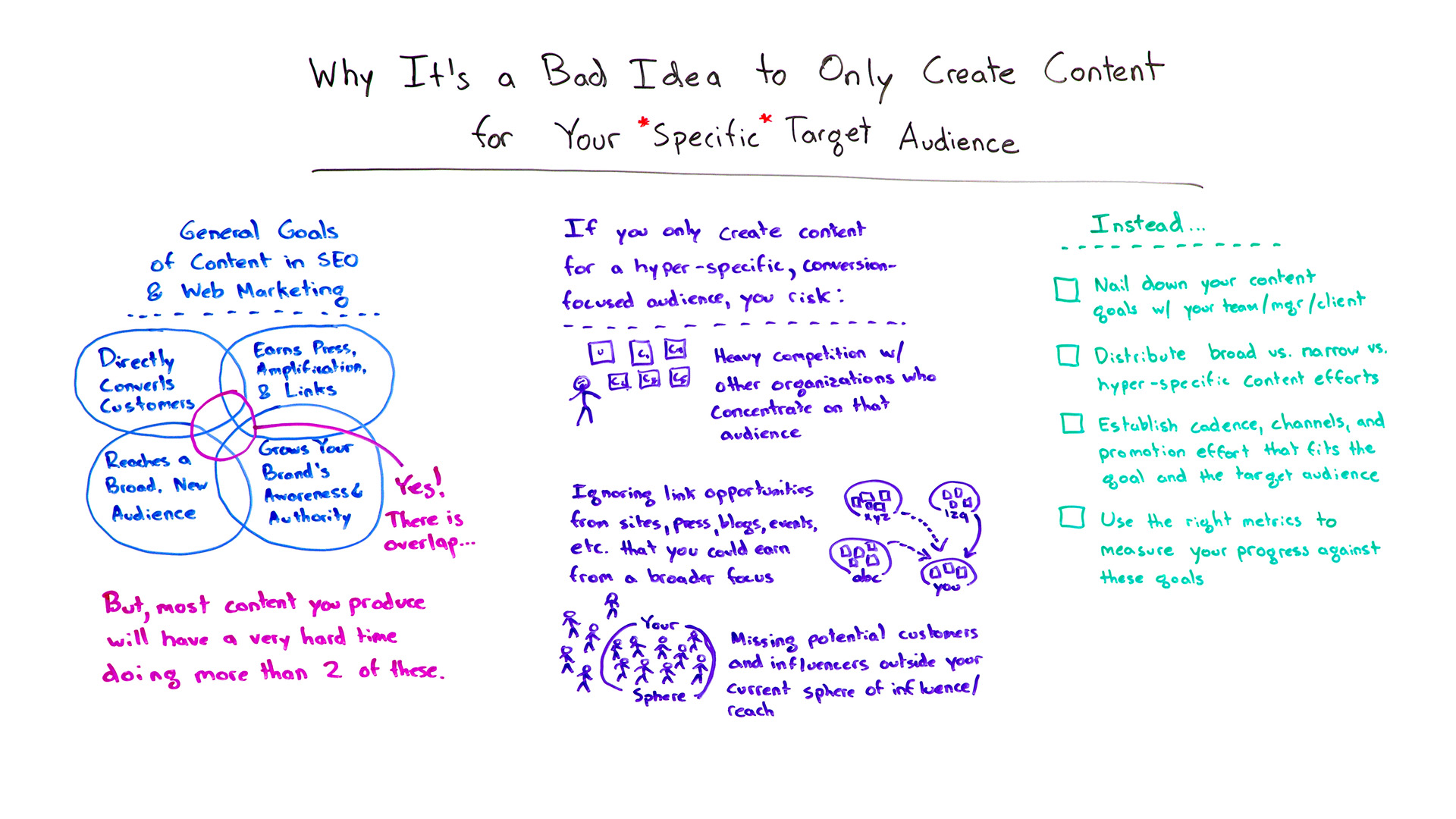
Click on the whiteboard image above to open a high resolution version in a new tab!
Video Transcription
Howdy, Moz fans, and welcome to another edition of Whiteboard Friday. This one comes to us via submission from email. This is a question from Michael. No other details given, which is totally fine, Michael. So he wanted to know, since he's working on a content strategy, working on a new blog and having conversations with his manager and his team about, "Hey, should we be writing only extremely focused, narrowly focused content for our specific target audience, or should we be trying to branch out and broaden so that we can reach a bigger audience or a new audience?"
I think this is a fair question, a great question that happens all the time in content strategy and actually in link building strategy discussions around the SEO and content world. So I think it's actually a pretty bad idea most of the time. Not all the time, but most of the time it's a pretty bad idea to be extremely narrowly focused on exclusively your audience, your paying customers or the audience that you're trying to get to pay for your products or services, and I'll explain why.
General goals of content in SEO & web marketing

So general goals that we usually have around content marketing and content as it relates to SEO and web marketing more broadly is that we want something that potentially
- Directly converts some customers, convinces people to buy from us, convinces them that our products or our services or our knowledge, or whatever it is, is the best in our field.
- Helps us earn press, amplification, and links, certainly so that we can rank higher for all sorts of things, so that we can reach new audiences, so that we get influencers on our side.
- Reach brand new audiences, broad, hopefully new audiences so that we can capture among that new audience some segment or sliver which is going to turn out to be great customers for us, now or in the future, or might be influential to our customers now or in the future.
- Grow our brand's awareness and authority. We're just trying to get seen by more folks, more people aware of us so that we can do all sorts of clever things in the future, like have higher click-through rates because people are familiar with us already so that we can do retargeting and remarketing, so that we have more brand credibility of all kinds in all sectors.
Usually, most content goals fall into one of these or several of them.
Now, there's overlap between them. I haven't perfectly illustrated this with a great Venn diagram. But in here there is lots of overlap between these different goals. You could have a piece of content that is both designed to earn press and amplification and links and is reaching a broad new audience. Or you might have some content that is directly converting customers that maybe also has some link amplification sorts of overlap. It's pretty tough to overlap anything else with directly converting customers, but the other three definitely easier to do overlap.
However, most of the content you're going to produce is going to have a hard time doing anything more than maybe one or two of these. If you're trying to do three or all four at the same time, you're going to struggle significantly. This is why folks who say, "I want content that's going to go viral, that directly converts my customers, that also reaches influencers and helps me reach a broad new group of folks," you're asking too much from the same piece of content. It's going to be a real, real challenge.
Risky business
 If you're only doing that content that's hyper-specifically targeting these directly converting customers, you're going to run into some big problems. First off, heavy competition. It tends to be the case if you're trying to earn that audience's attention, so too are all your competitors, and they're probably trying in very, very similar ways. It's often a competitive advantage to actually be a little bit broader and to branch out of that.


Finally, you're probably missing potential customers and influencers that are outside what your current sphere of influence is. Whatever that sphere is, the content that is most targeted at your audience is going to have a very tough time making this any bigger than it is. The content that's more broadly-focused, especially if it does well, is going to help expand this sphere so that you reach more of these people over here with that new expanded sphere.
All the right moves
My recommendations, instead of making your content way narrowly focused, I would try and think broader, and I would think about it in these ways. First off...
- Nail down the actual content goals with your team, your manager, or your client so that everyone agrees, "Hey, we want to do some of this, we want to do some of this, and we're looking to do a lot of this." If that's what we know our content is trying to do, it's pretty easy to have the conversation about why we shouldn't just create content here.
- Try and distribute those broad versus narrow versus hyper-specific content efforts. Distribute meaning say, "Hey, we know that we're going to be producing this amount of content. This is how much of it we want to put effort into to target this segment versus this segment versus this other segment."
- Establish some cadence, some channels, some of the promotion efforts that are actually going to fit the goal and the target audience, because you're going to do different kinds of promotion. It's not just a creation of the content itself and the content strategy, it's the promotion and the targeting. It's the channels you use, it's how often you put it out there, and it's where you put it on your site. It could be that you have a hyper-specific focused blog and then you have articles that are broader, or your blog is very broad and then you have white papers that are very, very focused on your target audience. Both ways are totally fine.
- Use the right metrics to measure your progress against these goals. If you're trying to reach a broad new audience, you're using thing like visits and exposure and engagement. If you're trying to grow press, amplification, and links, well, you're looking at links, you're looking at coverage, you're looking at mentions. If you're trying to directly convert customers, you are going to be looking at conversion events and whether that content falls somewhere in the conversion path over the course of time.
You do these things right, I think you're going to have a much more successful conversation when it comes time to say, "Should we create broad content or specific, hyper-focused content?"
All right, everyone, look forward to your comments and we'll see you again next week for another edition of Whiteboard Friday. Take care.
Video transcription by Speechpad.com
Sign up for The Moz Top 10, a semimonthly mailer updating you on the top ten hottest pieces of SEO news, tips, and rad links uncovered by the Moz team. Think of it as your exclusive digest of stuff you don't have time to hunt down but want to read!

Thursday, September 1, 2016
Using the Barnacle SEO Method to Prove Local Community Awareness
Posted by MiriamEllis
‘Barnacle SEO’ was a term first popularized by Will Scott in 2011 to describe the process of attaching your business to existing high-ranking entities (like major directories) and then promoting them as a means of dominating search engine results for desired terms.
Today, we’re going to take that novel concept in a different direction, with the goal of increasing brand awareness for single, multi-location, and enterprise local businesses by latching onto existing influences in any given community. Up ahead: simple tips for interpreting your city, a downloadable community awareness spreadsheet, and real-world examples for your inspiration!
Before we dive in, take a look at these two eye-opening statistics:
“73% of people care about the company, not just the product, when they’re making purchasing decisions.”
– BBMG
“63% of global consumers would buy from a company they consider to be authentic, over and above competitors.”
– Cohn & Wolfe
The Cohn & Wolfe survey of 12,000 participants included these definitions of authenticity consumers care about: the business stands for more than just making money (74%), has a relevant and engaging story (43%), and is well-known in its region or field (63%). The combination of these three statistics should ring bells with any local search marketing expert or department.
Today is the last day you'll ever worry over what to write about
Independently owned businesses hit roadblocks when they fear they have nothing real to say. Multi-location businesses fret over meaningful differentiation of one location from another. Large enterprises struggle with fostering local authenticity because the distance between the CEO and the clerk behind the checkout counter is sometimes too great, and brand-wide initiatives may result in generic, rather than truly local, messaging.
How to overcome these challenges? The solution lies in realizing that almost any given community is already writing your local story; you just have to discover how to latch onto it.
A significant portion of your blog posts, social outreach, and even paid advertising can be based on the fact that there are local, national, and global influences already firmly established in the minds of your consumers, almost every day of the year. Whether it’s the small-town 4th of July BBQ or the big-city Earth Day celebration, there are events, holidays, weather patterns, long-standing customs, and emerging news items of which your customers are already aware. Your barnacle local awareness marketing simply involves tying your business into pre-existing conditions, proving that you, too, are aware.
Barnacle example #1
To put it another way, you don’t have to tell a customer that summer has arrived. He already sees the sunshine and feels the heat. But if one of the branches of your home improvement franchise is located in a steaming hot, asphalt-topped shopping center, you can:
- Set up a big, friendly, self-serve cooler of iced tea and invite customers to pop in for a free drink.
- Erect a doggy drinking station under a shady overhang and let customers know they can stop by anytime.
- Set up a few quality lawn chairs next to your big display of high-powered fans and invite customers to take a seat and enjoy the breeze.
- Blog, tweet, post, hang up signage, and otherwise share your call for neighbors to come cool off while they’re making their usual shopping rounds.
- Hold a summer contest with a prize of vouchers for the local swim center or other refreshing retreat.
- Sponsor the swim center and earn a sponsorship listing on their website
All of this says you’ve noticed it’s summer, too, that your customers are perspiring, and that you’d like to help. Your outreach establishes your goodwill and an extra reason to visit your business.
Barnacle example #2
Or maybe yours is a large natural foods store enterprise, and you’ve got a location in Albuquerque, New Mexico. Every October, the city hosts the famed week-long Albuquerque International Balloon Fiesta. Your customers are already aware of this event, already talking about it, and making plans surrounding it. Your proofs of local awareness could include:
- Sponsorships
- Donations of money or supplies
- A food booth at the event
- An event photo contest with a nice prize
- In-store specials on picnic items to take to the event
- Fun tips for planning a great picnic meal
- ‘Secret’ insider info on great parking spots near the event grounds
- Staff photos of the fiesta
- Sharing all of the above on your website and social profiles
Your outreach will put this branch of your enterprise right in the middle of a major community happening, establishing your local awareness.
With even a modest application of research and brainstorming, chances are, your community is literally overflowing with inspiration for barnacle local marketing opportunities. For efficiency’s sake, organization will play a key role in planning your schedule of timely outreach. Read on!
4 simple steps to becoming a seaworthy Barnacle Marketer
1. Start with a spreadsheet
There’s nothing quite so organized as a good old spreadsheet, and to save you trouble, we’ve created this one for you, pre-filled in with major holidays and a few influences and fields we think will help you get started. Some holidays are on fixed dates, of course, but you’ll want to edit the dates of others each year.
Here’s an example of what a completed spreadsheet might look like for the month of September for a hypothetical major medical center in the city of Boise, Idaho:

Access your complimentary spreadsheet here.
To make a copy for your own use, simply select “File” from the main menu, then “Make a copy.” You can then add in your own events, change up the formatting, translate it to Swahili, whatever you’d like.

2. Do local, national, and global research
Almost every local Chamber of Commerce website has an events calendar which will detail most significant community happenings. You can also use sites like Eventbrite for further inspiration. And, indeed, there are paid opportunity-finding services like ZipSprout that can do the work for you and hook you up with with relevant sponsorship matches. Remember, you’re looking for well-known happenings that are already part of your customers’ consciousness — events that they are seeing advertised around town, promoted on the web, local TV, and radio.
On the national/global side, major news sites will be your best bet. Some events (like international summits or sports championships) are publicized well in advance. Others will require-up-to the minute awareness of items in the ‘15 minutes news cycle’ that could impact your customers in some relevant way.
Gather links as you do your research and enter them in the spreadsheet.
3. Identify opportunities for participation & promotion
In our hypothetical example, the medical center has identified 2 holidays, 1 national/global influence and 3 local events in September. Their participation in these 6 existing circumstances might be broken down like this:

Image via Pixabay
Labor Day (9/5)
Given that this national holiday honors workers, the medical center has an opportunity for outreach about preventing common work-related injuries like carpal tunnel syndrome, eye strain from computer use, or back problems caused by heavy lifting or improper footwear.
Promotional Opportunities: The doctors could hold a free work-safety seminar for local start-up owners and blog about it. They could also post simple preventative health tips for workers on Facebook and Twitter. They could run an Instagram campaign with photos of optimal vs. risky postures for sitting, standing, and lifting at work, engaging the audience to check whether they are practicing good habits.

Image via Jeremy Noble
Local Labor Day Picnic (9/5)
Local traditions like this are a natural opportunity for sponsorships. New to sponsorships for local businesses? This excellent guide will give you a crash course. The medical center could simply help provide funds for the seating, food, and entertainment in exchange for being listed as a sponsor on promotional materials, or they could take a more active role. They could set up a booth at the picnic, offering refreshments high in electrolytes to rehydrate picnic-goers, or maybe free 5-minute therapeutic foot massages, or UV-protective sunscreen.
Promotional Opportunities: To truly ‘barnacle’ onto this event, the medical center should promote both it and their participation in it on their website and social profiles. Posts, tweets, and images to the tune of “Treat tired feet to a free massage by a licensed practitioner at the Labor Day Picnic, courtesy Green of Tree Medical Center,” with links to the event website would all be good. Promote the event, promote yourself.

Image via Clemens v. Vogelsang
Art in the Park (9/9–9/11)
Billed as one of the premiere art events in the Northwest, this annual Boise exhibit is another sponsorship no-brainer. These days, most event committees clearly post calls for sponsorship on their websites, and the really savvy ones detail exactly what sponsors can expect in return in terms of brand promotion including signage, blog posts, and social mentions. So, that’s one option. Another is to barnacle onto the idea that art serves many purposes in the human community and is, in fact, used as a form of therapy. If the medical center is full-service, there's a clear opportunity to connect health and art.
Promotional Opportunities: If the medical center is an event sponsor, they could promote the event on the clinic’s website, and tie the theme into the practice of art therapy. This would be an excellent month to raise awareness of the center’s group art therapy sessions, or to offer a series of social media tips about the ways in which many art forms are believed to have a positive impact on everything from depression to stroke recovery. Or, perhaps some of the doctors’ or patients’ artwork will be featured in the event. What a great chance for some Pinterest marketing and an invitation to come see more of this work hanging in the medical center’s reception area!

Image via bark
First Day of Fall (9/22)
At first glance, many businesses may struggle to see how they can tie in with community awareness of leaves changing color or pumpkins ripening, but it just takes a little ideation. The medical center might launch a Healthier Boise campaign, with free flu shots, reminders to get asthma inhaler prescriptions refilled against the coming onslaught of woodstove smoke, and healthy recipes for using all those butternut squashes and greens in the market for optimum vitamin intake.
Promotional Opportunities: The campaign can be promoted on all of the medical center’s social profiles, as well as on the homepage of the company website, supported by additional pages or posts of useful content. This would be a smart time to interview some of the clinic’s doctors on general preventative medicine tips to strengthen the community for the coming cold season.

Image via Susumu Komatsu
Walk to End Alzheimer’s (9/17)
A renowned event like this offers remarkable, diverse opportunities for advocacy, sponsorships, and donations. Doubtless, numerous staff members will be participating in the walk and the medical center can tell the story of this while also tying this into ongoing research and services relating to Alzheimer’s at their facility.
Promotional Opportunities: Event booths, individual sponsorships, staff photos, patient photos, fundraising goals, and education can all be socially promoted. Participation in a large event like this deserves top billing on the website homepage, too, backed up with blog posts.

Image via Pixabay
Global Obesity Summit Los Angeles (9/26 - 9/28)
Most industries have summits, conferences, and events that will be attended by staff members and, often, consumers as well. Given how often America’s obesity epidemic is mentioned in mainstream media, the medical center can see in this important global event an opportunity for education and outreach on a very current topic. Sponsorship opportunities are easily apparent. Or, if one or more of the doctors will present at the summit or even just attend, their research and discoveries can then be shared with the city of Boise.
Promotional Opportunities: Staff participants can be interviewed for the blog, offering new suggestions for maintaining a healthy weight based on summit presentations. If the medical center offers exercise classes or dietary counseling, here’s a perfect opportunity to reach out socially with a free first session offer to the community. Could be a fun time to experiment with Snapchat. Be as generous as possible in sharing tips that could improve patients’ lives.
Even at a glance, it’s easy to see that a local business can quickly fill every calendar month of the year with community outreach and promotion of the company’s involvement. Don’t forget that to be a good barnacle, you’ve got to promote awareness of community happenings as well as promoting your own participation in them. Put up in-store flyers and posters, tweet, share, and chat!
I’d further recommend tracking the outcomes of each campaign so that you learn, over the course of the next couple of years, which events and which forms of participation resonate most with a given community and result in the greatest ROI for the business.
My question for our readers: Which forms of tracking do you use to measure success from these types of activities? Please, share your expertise to benefit the community!
4. Designate a Local Expert at each business location
Hopefully the above three steps will already have the wheels turning about how your brand can discover and participate in the influences your potential consumers are already aware of, but doubtless, this questions arises:
“Who's going to do all of this work?”
The answer is, you’re going to need to give an existing employee or a new hire the nifty title of ‘Local Expert.’ If you’re the owner and your business is very small, the Local Expert may have to be you until you grow the company a bit more, but for most small-to-large local businesses, local marketing is vital enough to be a genuine job.
Multi-location companies and large enterprises should expect to appoint a Local Expert for each branch, or at least for each city in which the business operates. In the interview process, here are 5 things you want to look for in an existing or new staff member that should spell success:
- Has lived in the target city for some years. A born-and-bred local would be my ideal, because she may be aware of cherished history and customs beyond the ken of newcomers, but let’s stipulate that the Local Expert has lived in the region for at least a couple of years.
- Has above-average communication skills, both in person and on the web. Your expert will not only be socially promoting your company’s participation in events (necessitating interaction with the community), they will also likely be on the phone with event holders and attending some events in person. Be sure you feel confident about this person representing your business and that they have the real-world social skills necessary to foster excellent interactions.
- They must know or be willing to learn the basics of Local SEO. Even if this staff member has nothing to do with optimizing your website or managing your citations, they must understand that the core goal of all of their work will be increasing the local visibility of your brand. They need to understand how local search works to comprehend why this is such a big deal.
- They must know or be willing to learn local/social media marketing. If the candidate for the job can reel off the things they're already doing on YouTube, Twitter, Facebook, Snapchat, Instagram, Periscope, smartphone apps, and their personal blog, you’ve got a winner on your hands. Better still if they tend to be ahead of the social technology curve and are able to identify trends in the popularity of various platforms that could spell out innovative opportunities for your local marketing.
- They should bring a sense of excitement and fun to the work. Based on the barnacle principle, your Local Expert should be energized by the task of promoting both his city and his workplace, enriching the community with useful information. This is one job in which enthusiasm will really shine through in the final product.
Would some real-world inspiration really get you going?
I always find it easier to conceptualize tasks when I take a look at what others have done. If that goes for you, too, here are some real-world examples of local awareness proofs.
- Here’s an inspiring story about a NYC-based organization called New Women New Yorkers which helps immigrant women gain access to resources that will make their lives safer, more profitable, and more interesting in their new country. A local Lebanese restaurant called Manousheh answered the organization’s call for sponsorships and donations for an event, and was thanked on an events page and mentioned on events sites like this one. To close the barnacle loop, all the restaurant needs to do is start a page on their own site mentioning that they support this organization and that they participated in an event. It would be nice, too, if the organization would make sponsor logos link to their websites. Everybody is off to a good start here and just needs to go one step further.
- 2016 marked the 41st anniversary of a Santa Fe event called Pancakes on The Plaza. Local bank First National of Santa Fe comes out as a winner with a featured logo on this sponsors page and with a barnacle shout out on their own website, promoting both their participation and the event, plus proud mentions on their Facebook page. The deal is further sweetened by blog mentions like this one, this one, this one... and the list goes on!
- And here’s a delightful example of just how grateful a really motivated business can be to its sponsors. In this case, the Prince Edward Island Potato Board is getting all kinds of Twitter love from a local restaurant and live theater venue:

And PEI Potato barnacles on like pros, holding a contest for tickets to a summer musical performance at the sponsored theater:

If restaurants, banks, & potato growers can do it, so can you!
Your community is already alive to the influences surrounding it: businesses, events, organizations, seasonal traditions, and relevant news. You don’t have to write a new story from scratch; you just need to discover where you fit into the existing storyline. Generosity, creativity, and a genuine desire to contribute to community well-being are what it takes to become a visible player in local life.
Has your business been using the barnacle method all along to prove local awareness? Our Moz community would benefit from your inspirational stories. Please share them in the comments!
Sign up for The Moz Top 10, a semimonthly mailer updating you on the top ten hottest pieces of SEO news, tips, and rad links uncovered by the Moz team. Think of it as your exclusive digest of stuff you don't have time to hunt down but want to read!

Subscribe to:
Posts (Atom)